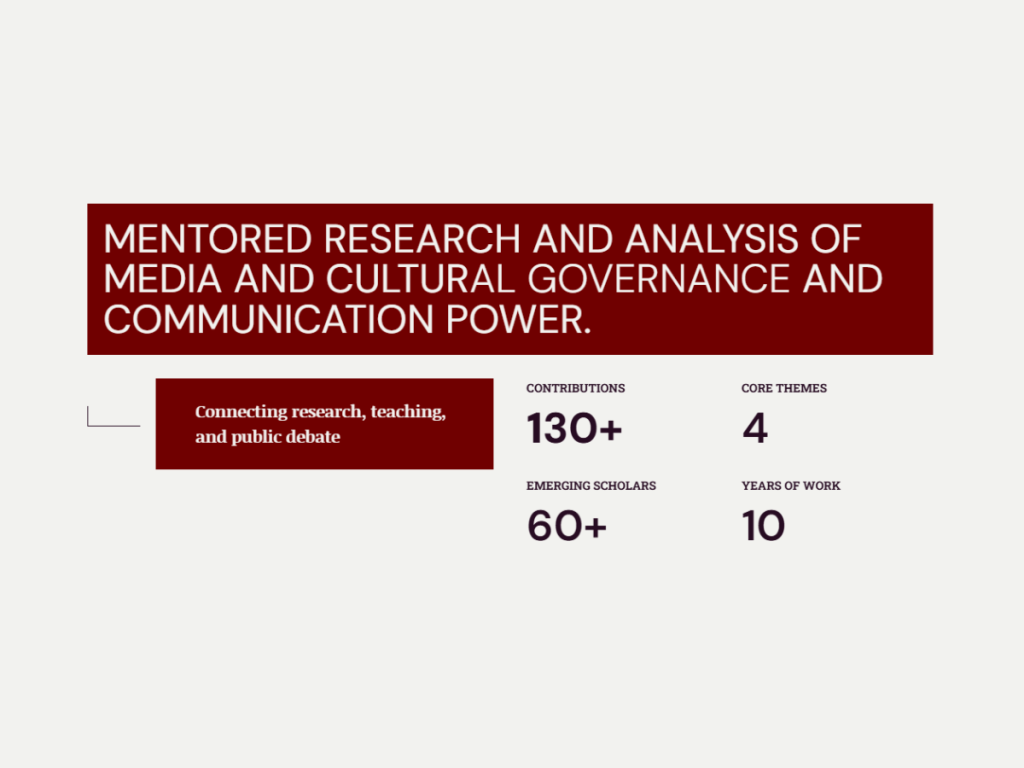
mentored research and analysis of media and cultural governance and communication power.

contributions

130+

emerging scholars

60+

core themes

4

YEARS OF WORK

10


close up shot of a monitor screen
Photo by I’m Zion on Pexels.com

About digital technologies, data, and AI transforming media, governance, and public communication, and what these shifts mean for society ahead.

close up of hand with megaphone on demonstration
Photo by Lara Jameson on Pexels.com

About representation, participation, and communicative justice, asking whose voices are heard, whose are excluded, and how inclusion is negotiated.

SHAPING POWER

group of protesters gathered together on a public place
Photo by Colin Lloyd on Pexels.com

About power dynamics in media and communication, how influence is built and exercised, and how institutions, platforms, and actors shape public life.

justice figurine on table
Photo by KATRIN BOLOVTSOVA on Pexels.com

About the rules, structures, and frameworks organising media systems, from policy to platform governance and institutional accountability.
  • Who Frames the Frame?: Gender, Power and Policy in European Cinematography

    by Daniel Foss Think about the last series you streamed or the latest film you watched in the cinema. You probably remember the lead actor, perhaps the director. But do you know who was behind the camera? And more specifically: have you ever noticed how rarely that person is…

  • Platform  transparency is a democratic political claim: TikTok Politics of Visibility, Bias, and Influence

    by Nathalie Clara Hutter , Universität Wien  UNESCO and various media outlets have increasingly raised concerns about the impact of social media on democratic discourse (UNESCO, 2025). TikTok, once known for dance trends and lip-sync videos, has quickly evolved into a tool for political communication. Its unique algorithm, short…

  • Protect the youth! A case against personalisation through algorithms

    By Amelie Wagner    Following Donald Trump’s inauguration in January 2025, search results on Instagram for the hashtags “Democrat” or “Democrats” were suddenly no longer visible. Meta, the owner of Instagram, denied accusations of hiding related posts, blaming a technical error instead (Gerken, 2025). On an algorithm-driven platform like Instagram,…

  • Who is responsible? Streaming and Sustainability Beyond the Individual 

    By Agnes Bruinsma (MA Student, Department of Communications, University of Vienna) Watching an episode or film on Netflix or Disney+ may not seem like an activity that could harm the environment. There is no visible waste, no sense of fuel being consumed, and no immediate indication of how much…

  • When the World Gets Too Loud, Europe Speaks Through Animation

    Aleksei Baulin  Turn on the news today and the feeling is familiar: war in Ukraine and Palestine, demonstrations in Iran, Trump’s plans to annex Greenland and confrontation within NATO, Venezuela… political polarization in the EU, climate anxiety, economic uncertainty… The list is endless. Europe is once again living through…

  • European Media Sovereignty: The Question We Keep Avoiding

    There is a word circulating in European policy corridors with increasing urgency: sovereignty. Energy sovereignty. Technological sovereignty. Strategic sovereignty. Digital sovereignty. Europe has spent the better part of this decade discovering, often painfully, the cost of dependency. And yet when it comes to media and culture, the continent continues…

  • The Power of the Underdog: Why European Animation Can Dare More Than Hollywood

    by Natalia Sineokaia Almost any major Hollywood animation studio is ultimately governed by numbers. Market success today lies not so much in shaping narratives as in sensing and servicing socio-political demand: introducing a carefully measured, three-second-long “first” queer character when the cultural climate allows it, or, amid a global…

  • A Look Behind the Lens: Gender Disparities in Cinematography in EU-Funded Films

    by Anne Waack As the 2026 award season unfolds, film audiences are once again celebrating the artistry of cinematography. Lighting, framing, and camera movement shape how stories feel. They can make a scene intimate, tense or unforgettable. Yet this year’s nominations also raise a bigger question: who actually gets…

  • Selling Games, Selling Gender: Women on Video Game Covers

    by Magnus Reinel The days when video games were a niche hobby are long gone. They are part of everyday culture and are actively promoted across social media, streaming platforms, and digital storefronts like Steam. One of the most visible and influential elements of this promotion is the game…

  • AI is not gender neutral: Will AI silence female voices in animation?

    by Ceren Emiroglu In late 2025, Disney and OpenAI announced a deal that brings more than 200 famous characters into Sora, turning prompts into short videos and images. For fans, this collaboration seems like an exciting milestone: instant creativity, instant nostalgia, instant shareability. For the industry, though, it’s also a clear signal…

The Media Governance Lab Blog publishes mentored research and analysis on media, platforms, and communication power. It brings together emerging scholars writing on media and cultural governance, with attention to how communication systems are structured, regulated, contested, and transformed. Developed within the University of Vienna’s Media Governance Lab, the blog connects research, teaching, policy debate, and public discourse.

The Media Governance Lab at the University of Vienna brings together research, teaching, and public engagement on media and cultural governance. Its work addresses changing communication structures, the growing role of platforms and infrastructures, and the consequences of these developments for democracy, rights, accountability, and public life. The blog forms part of this broader intellectual and institutional effort.

The blog is developed under the direction of Katharine Sarikakis, Professor of Media Governance, whose work examines communication power, media governance, and inequalities of voice. It functions as a mentored publication space where students and early-career researchers strengthen analytical writing through light editorial guidance, conceptual grounding, clarity of argument, and sustained engagement with wider academic and real-world debates.

For any questions, requests, or permissions, please email us at katharine.sarikakis@univie.ac.at