Chetanay Wahi
Research Assistant, Horizon Europe Project ANIMA MUNDI
Media Governance & Industries Research Lab
University of Vienna
This blog post critically analyses how European media and cultural governance addresses, and fails to address, ethnic diversity within the cultural workforce. Drawing findings from the stakeholder workshop of the Horizon Europe project Anima Mundi, it argues that while European audiovisual policy has developed strong mechanisms for promoting diversity on screen, it has left the structural conditions of workforce exclusion largely ungoverned.
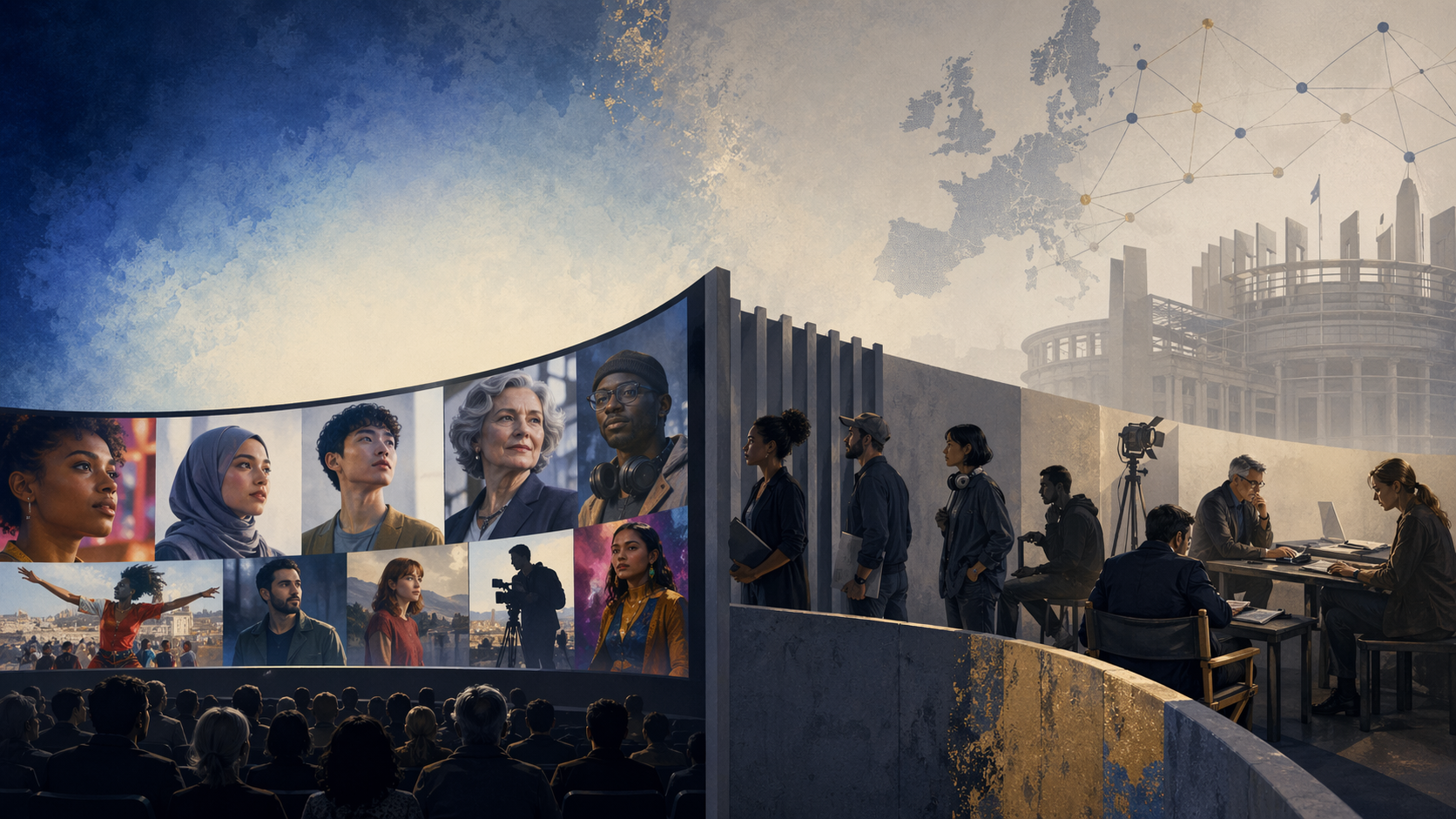
Europe animates diversity, but who animates Europe? Productions like Dounia & the Princess of Aleppo and Pablo, which explore refugee displacement and neurodivergence, help Europe define itself through socially engaged narratives. This progressive output is perfectly aligned with the EU’s Creative Europe MEDIA programme and its priority of promoting cultural diversity and inclusion (European Commission, 2026). Consequently, on-screen representation projects a highly egalitarian industry. Yet, who authors these narratives? Empirical data gathered through stakeholder workshops for the Horizon Europe project Anima Mundi (an initiative designed to unlock the sector’s potential through evidence-based strategy) reveals a representational paradox. The inclusive stories celebrated on screen are overwhelmingly manufactured by a structurally homogenous workforce, laying bare the limitations of current cultural governance.
The gulf between what is depicted and who is employed
The dissonance between progressive storytelling and production realities is starkly evident in the sector’s demographic composition. Broad, sector-wide analyses have previously documented a persistent underrepresentation of ethnic minorities in key creative and technical roles across the United Kingdom and Denmark (Cabrera Blázquez et al., 2021). This scarcity is corroborated by on-the-ground testimonies. Production professionals describe animation crews of forty to fifty personnel with only a single person of colour (Sarikakis et al, 2025). Gender inequality has successfully achieved institutional attention and has become a standard metric in equality debates, policy initiatives, and regular monitoring (European Audiovisual Observatory, 2023). Racial and ethnic diversity, by contrast, remains barely measured and largely invisible to the governance platforms through which the sector monitors itself (Loots et al, 2024). This discrepancy constitutes a fundamental governance failure, wherein systemic exclusion is maintained through institutional illegibility.
The architecture of exclusionary gates
To understand this demographic incongruity, the process of exclusion must be traced long before the point of hiring. Access to the European animation workforce is mediated by a successive chain of structural barriers. The pipeline narrows at its very source, educational stratification. Workshop participants from creative incubators observed that admission to elite European animation academies is fiercely competitive and often predicated on social background (Sarikakis et al, 2025). The candidate pool is filtered by class well before any professional engagement begins. Aspirants who navigate the educational bottleneck immediately confront a second barrier: informal recruitment. Stakeholders describe an industry built on word-of-mouth recommendations. When the incumbent workforce is largely white and drawn from identical educational pedigrees, recruitment acts as a closed loop, reproducing existing demographic compositions. The sector’s reliance on unpaid internships further entrenches this precarity, effectively barring working-class and minority individuals who lack the financial safety net to sustain unremunerated labour (Marshall, 2025). A third constraint operates at the level of finance itself. Professionals note that regional funding often mandates studios to hire within strict geographic borders (Sarikakis et al, 2025). In smaller, more homogenous labour markets, these rules penalise diverse recruitment by design. Diversity is constrained not by a lack of talent, but by the rigid geography of the capital that funds it.
Outsourcing inclusion to the periphery
The existing governance response to diversity in European animation reveals a regulatory asymmetry. It is mainly output-oriented and gender-focused. European audiovisual policy has evolved from a strict gender-equality paradigm into a broader framework encompassing ethnicity, social background, and disability (Cabrera Blázquez et al., 2021; Audiovisual Sectoral Social Dialogue Committee, 2025). However, the institutional mechanisms driving this shift (targeted quotas, funding bonuses for women directors, and dedicated festival programmes) remain calibrated almost exclusively to gender. Equivalent mechanisms for ethnic diversity are virtually nonexistent. When the governing logic of cultural policy prioritises competitiveness over equity, the result is predictable: ethnic inclusion is relegated to soft guidelines and self-regulation that the industry can adopt or ignore at will. (Sarikakis et al, 2009)
European media governance has effectively outsourced ethnic equity to the periphery rather than embedding it into the architectures of funding, education, and recruitment. Findings surfaced through the REBOOT project show that racial diversity within the European audiovisual sector is largely peripheral, maintained by independent, community, or activist networks rather than integrated into mainstream funding and policy systems (Sarikakis et al, 2025). Isolated state frameworks like France’s Fonds Images de la Diversité provide tangible pathways. Yet, inclusion in nations like Austria and Belgium relies heavily on community-based initiatives such as Cinemaximiliaan and Diverse Geschichten, while in Greece and Spain, grassroots activism fills the gap with limited state support, and in Poland, migrant creators remain almost absent from the narrative landscape. When systemic equity is relegated to voluntarism and activist labour rather than institutional design, inclusion remains inherently fragile and unevenly distributed.
The contested politics of diversity
There is no post-racial or post-gender consensus within the European animation sector. Industry testimonies reveal significant internal resistance, with some professionals arguing that characters of “unfamiliar” ethnicities fail to resonate with national audiences, effectively deploying marketability to justify representational exclusion (Sarikakis et al, 2025). This resistance frequently intersects with sexism. Workshops documented professionals dismissing gender inequality as fabricated or propagating the stereotype that women are inherently less suited for creative and technical leadership. These frictions expose a sector that remains fractured over the operational definition of diversity, the metrics used to track it, and how deeply structural inclusion efforts should actually go.
European media governance does not operate above this ideological fray. Its entanglement is most glaringly exemplified by Hungary’s Propaganda Law, which prohibits the depiction of homosexuality or gender diversity in media accessible to minors (Amnesty International, 2024). Here, state power actively suppresses the inclusive values that EU-level policy nominally champions. The crisis of diversity in European animation is therefore not a benign gap between rhetoric and reality but a hostile contradiction within the architecture of European governance itself, wherein the mandate for inclusion is perpetually subverted by both industry traditionalism and reactionary state legislation.
The legitimacy of Europe’s cultural self-image
The European Union positions diversity as a foundational pillar of European citizenship (Sarikakis, 2007). A representational contradiction therefore emerges when the institutional architecture systematically filters out the very populations whose narratives are often celebrated on screen. This contradiction undermines creative authenticity, destabilises authorial legitimacy, and ultimately fractures the integrity of Europe’s cultural self-image. It is within this critical juncture that the Anima Mundi project situates its interventions.
Convening industry stakeholders to map sector-wide challenges, the workshops illuminated the shared structural frictions and the shared silences. Ethnic diversity emerged as the dimension participants most readily acknowledged as vital, yet most struggled to articulate or resolve. Dismantling this architecture of exclusion must begin by exposing the silence that sustains it.
This blog post was written as part of the Horizon Europe project ANIMA MUNDI, which explores the specific needs and underexplored strengths of the European animation industry. For more information, please visit the ANIMA MUNDI website.
References
Amnesty International. (2024). From freedom to censorship: The consequences of the Hungarian Propaganda Law (Index: EUR 27/7571/2024). https://www.amnesty.org/en/documents/eur27/7571/2024/en/
Audiovisual Sectoral Social Dialogue Committee (2025) Diversity and inclusion. Achieving gender equality and promoting diversity in the European Audiovisual sector. https://www.equalitydiversityinavsector.eu/diversity-and-inclusion
Been, W., Wijngaarden, Y., & Loots, E. (2024). Welcome to the inner circle? Earnings and inequality in the creative industries. Cultural Trends, 33(3), 255. https://doi.org/10.1080/09548963.2023.2181057
Cabrera Blázquez, F. J., Cappello, M., Talavera Milla, J., & Valais, S. (2021). Diversity and inclusion in the European audiovisual sector (IRIS Plus 2021-1). European Audiovisual Observatory, Council of Europe.
European Audiovisual Observatory. (2023, October 26). Only 26% of directors of European feature films are women. https://www.obs.coe.int/en/web/observatoire/2023-press-releases/-/asset_publisher/0t9kVBabnI8V/content/only-26-of-directors-of-european-feature-films-are-women
European Commission, Directorate-General for Communications Networks, Content and Technology. (2026, February 10). Creative Europe MEDIA programme. Shaping Europe’s Digital Future. https://digital-strategy.ec.europa.eu/en/policies/creative-europe-media
Keinonen, H., Wahi, C., Sarikakis, K., Rossato Fernandes, M., Tran, T., Tinen, P., Vlassis, A., Goffredo, S., Dâmaso, M., Turan, P., Sganga, C., De Potesta, A., Afilipoaie, A., & Ranaivoson, H. (2025). Set-the-Stage: Report on international promotion of European animation industry (Deliverable D4.1). Horizon Europe project ANIMA MUNDI (ID: 101178027). https://www.animamundi-values.eu
Marshall, K. (2025). Equality in the animation workforce: How close are we to a globally level playing field and how can a new school of digital arts contribute to progress? Brazilian Creative Industries Journal, 5(1), 157. https://doi.org/10.25112/bcij.v5i1.3687
Sarikakis, K., Biltereyst, D., Ramadani, G., Chatziefraimidou, A., Haslauer, S., Vanhoutte, B., Van Landschoot, J., & Zogo, Y. S. C. (2025). Recommendations on innovation for European film creators. The REBOOT Project. https://doi.org/10.5281/zenodo.15309331
Sarikakis, K. (2007). The place of media and cultural policy in the EU. European Studies, 24, 13–21.



Leave a Reply