by Iris Sailer
The series Maya the Bee is one of the most well-known children’s television programs in German and Austrian broadcasting history. In 2026 the famous children’s series celebrates its 50th anniversary. On this occasion, the company Studio 100 initiated a collaboration with Animaj Studios to continue developing Maya the Bee as a media brand for another 50 years (Studio 100 International, 2025). Since its first appearance as a handdrawn version, the series has undergone significant visual, narrative and content-related changes, particularly through its transition to a computer animation in 2013 (n-tv.de, 2011). These changes came along with shifts in marketing strategies and media presence, suggesting that key decisions for specific stylistic and narrative modifications are part of a broader branding strategy for Maya the Bee.
This contribution examines the adaptation of Maya the Bee from hand-drawn animation to computer-generated 3D production in the context of media governance. It argues that the series’ transformation is not only a technological update but also reflects broader commercial concerns that shape children’s media through branding, platform expansion, and marketing strategies. While children’s media is often framed as audience-oriented, this analysis shows that narrative, character design, and pacing are increasingly structured by market logics. This challenges the assumption of audience-driven adaptation and raises broader questions about the growing influence of commercial interests in shaping children’s media content.
The transition from hand-drawn animation to computer-generated animation shows a drastic change in the design of the Maya the Bee, driven by technological developments in contemporary children’s media.The narrative world is now constructed in 3D, the colors are more vibrant, and characters are drawn in more detail. Maya the Bee, for example, has visible teeth in the 3D version and a clear hair design. Yet, the new version holds more than just an aesthetic update. Severe changes in pacing, narratology and content along with new character features can be noticed throughout the new episodes. In addition, the brand has also expanded to multiple media platforms such as Instagram or YouTube with adapted media content. In contemporary children’s media, the success of a television series is no longer solely determined by viewing figures but increasingly depends on integrated marketing strategies across media ecosystems. Therefore, a brand which is displayed across multiple platforms and in forms of merchandising products, must be created (Nussbaum, 2001, p. 86). Understanding this is important for assessing whether Maya the Bee’s adaptation is primarily audience-driven or marketing-driven, and how this affects the reception of different generations.
In order to identify the possible reasons behind these changes, the differences between the new and old versions must first be recognised and named. A qualitative content analysis based on Kuckartz & Rädiker (2022, p. 154) was conducted. Six episodes of the hand-drawn version and the computer animated version have been analysed. Additionally, guided interviews were held to collect opinions of representatives of different generations of the new composition. Findings concerning the narrative changes show that the new version is faster paced than the older one. It holds almost double the number of cuts and dialog exchanges per minute. Regarding content-related differences, the analysis confirms a simplification through reduction of complex conflicts, serious topics and educational elements. The most significant changes concern the character design of the protagonists Maya and her companion Willi: they appear with bigger eyes and their heads are much bigger in relation to the rest of their bodies. The findings from guided interviews indicate that both Generation X and Generation Z who grew up with the old version as well as Generation Alpha, who grew up in a time where computer animated shows were already common, preferred the old version.The slimmed character design, in particular, was much criticised.
Analysing the new character features, it is noticeable that they fit the criteria of the so-called “Kindchenschema” (Dydynski, 2020, p. 224). Studies show that big eyes and heads in relation to a small body are perceived as cuter and more sympathetic (Chen, Huarng, & González, 2022, p. 212). Since the cuteness of media characters play a central role in creating stronger attraction for potential customers, making the character cuter could indicate a strategic decision. Even more so when you take the 24/7 strategy of Studio 100 into account, which is based on creating as many merchandising products as possible to accompany children throughout the week (Elmendorff, 2009, p.59). The observed reduction of the complex conflicts and threatening natural events may also be explained by the younger target audience of the new version. It makes sense to tone down depictions of danger and death for preschoolers. However, educational elements were also cut back. Studio 100 has created a new colorful, almost perpetually cheerful world. Spring is the only displayed season in the show. In addition to targeting a younger audience, these changes may also reflect strategic decisions: a cheerful and colorful world can enhance a positive emotional connection between the character and the audience. Therefore, it supports positive associations and contributes to the commercial success of merchandising products. The last crucial point is the faster pacing of the new version. Aside from the new viewing habits of the younger generation, a faster speed benefits also the multiplatform marketing strategy. Scenes from the old version would never fit into Instagram reels for example. Due to faster pacing, approximately 15 seconds from an episode are sufficient to form a complete and coherent scene. In contrast, scenes of the handdrawn version take far more time to develop.
The adaptation of Maya the Bee illustrates the complex interplay between content adaptation, marketing strategies and audience reception. The research has shown that the visual, narrative and content related adaption from 2013 is not only a response to a new technology but also reflects strategic decisions in brand management and media presence. A cuter character design along with simpler narratives and faster pacing aligns well with the merchandising and multiplatform goals of Studio 100. Despite the intentions to make the appearances of the character cuter, respondents across different generations still prefer the hand-drawn version over the 3D version. It is particularly astounding that viewers review the 3D adaption, which was constructed to make the world more realistic, as more fictional than the hand-drawn 2D version. Following these research findings, the spin-off of Maya The Bee-Arnie & Barney presents an opportunity to assess whether further visual, narrative and content-related changes- especially concerning simplification- occur within the brand’s ongoing development.
This blog post was written as part of the Horizon Europe project ANIMA MUNDI (Project ID #101178027) at the Media Governance and Industries Research Lab. The project explores the specific needs and underexplored strengths of the European animation industry. For more information regarding the project, please visit the ANIMA MUNDI website.
References
Chen, C.-Y., Huarng, K.-H., & González, V. I. (März 2022). How creative cute characters affect purchase intention . Journal of business research., 142, 211-22
Dydynski, J. M. (2020, August). Modeling Cuteness: Moving towards a Biosemiotic Model for Understanding the Perception of Cuteness and Kindchenschema. Biosemiotics, 13 (2), 223-240. https://doi.org/10.1007/s12304-020-09386-9
Elmendorff, P. (2009). In Klassiker investieren. (D. M. Götz, Interviewer) https://izi.br.de/deutsch/publikation/televizion/22_2009_2/Elmendorff-In_Klassiker_investieren.pdf
Kuckartz, U., & Rädiker, S. (2022). Qualitative Inhaltsanalyse: Methoden, Praxis, Computerunterstützung : Grundlagentexte Methoden. Basel, Weinheim: Bektz Verlagsgruppe.
n-tv.de. (2011, April 26). Biene Maja neu und in 3D. Retrieved from n-tv.de: https://www.ntv.de/leute/Biene-Maja-neu-und-in-3D-article3179996.
Nussbaum, C. (2001). Buddel-Bobs Spielewelt. werben & verkaufen, 86.
Studio 100 International. (2025) STUDIO 100 INTERNATIONAL UND ANIMAJ: STRATEGISCHE ALLIANZ FÜR DIE ZUKUNFT DER BIENE MAJA.[Press Release] https://media.studio100international.com/media/sites/2/2025/10/e3316dac48-251001_s100int_presseinformation_strategische-allianz-mit-animaj_final.pdf
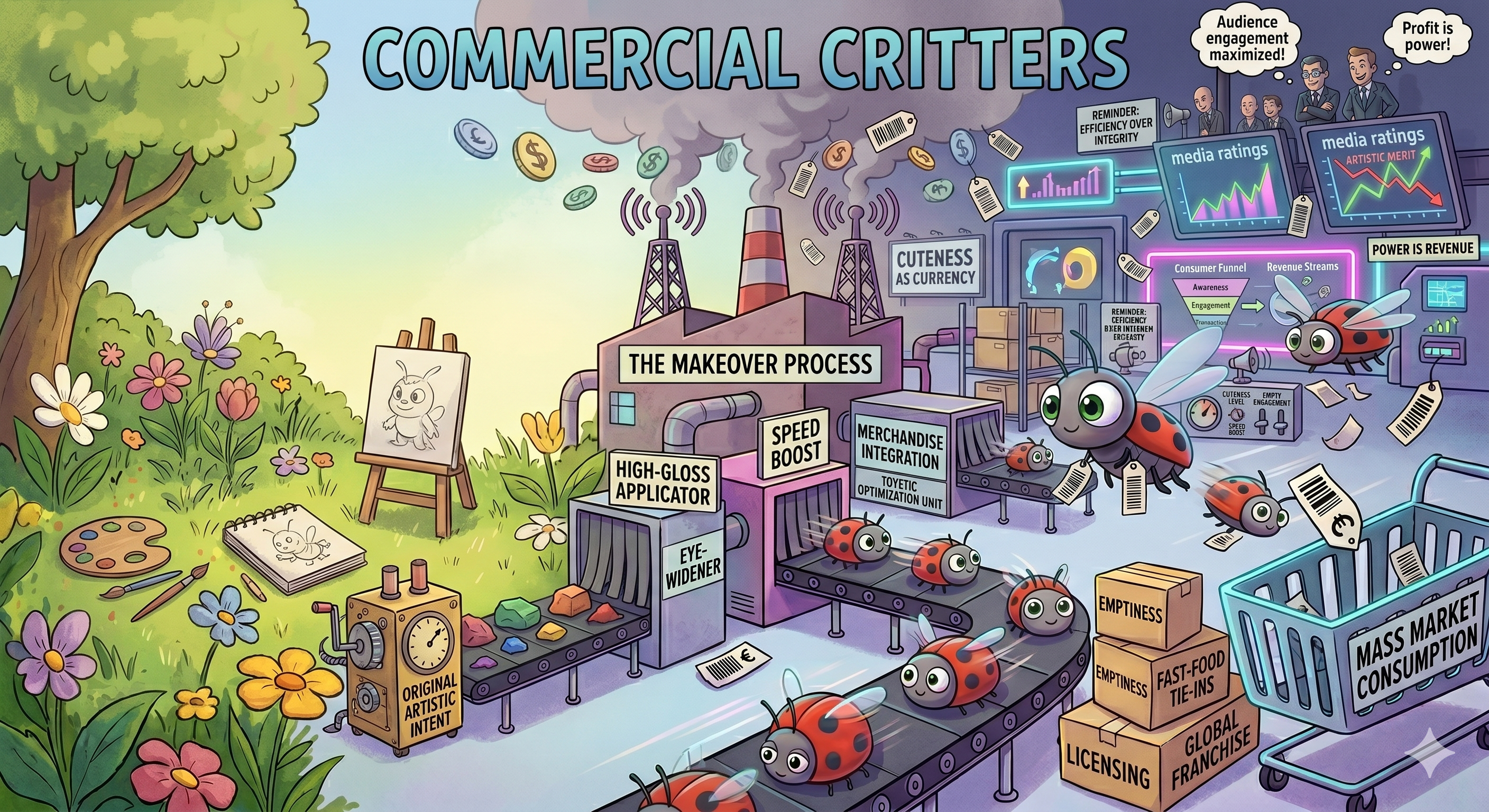
The featured image of this blog was generated using visual synthesis technology (Gemini 1.5 Pro). This statement is for informational purposes. For definitive guidance on legal and commercial use, please refer directly to the Gemini Service Terms and your local intellectual property laws.

Leave a Reply