By Chetanay Wahi
Research Assistant,
Media Governance & Industries Research Lab,
University of Vienna
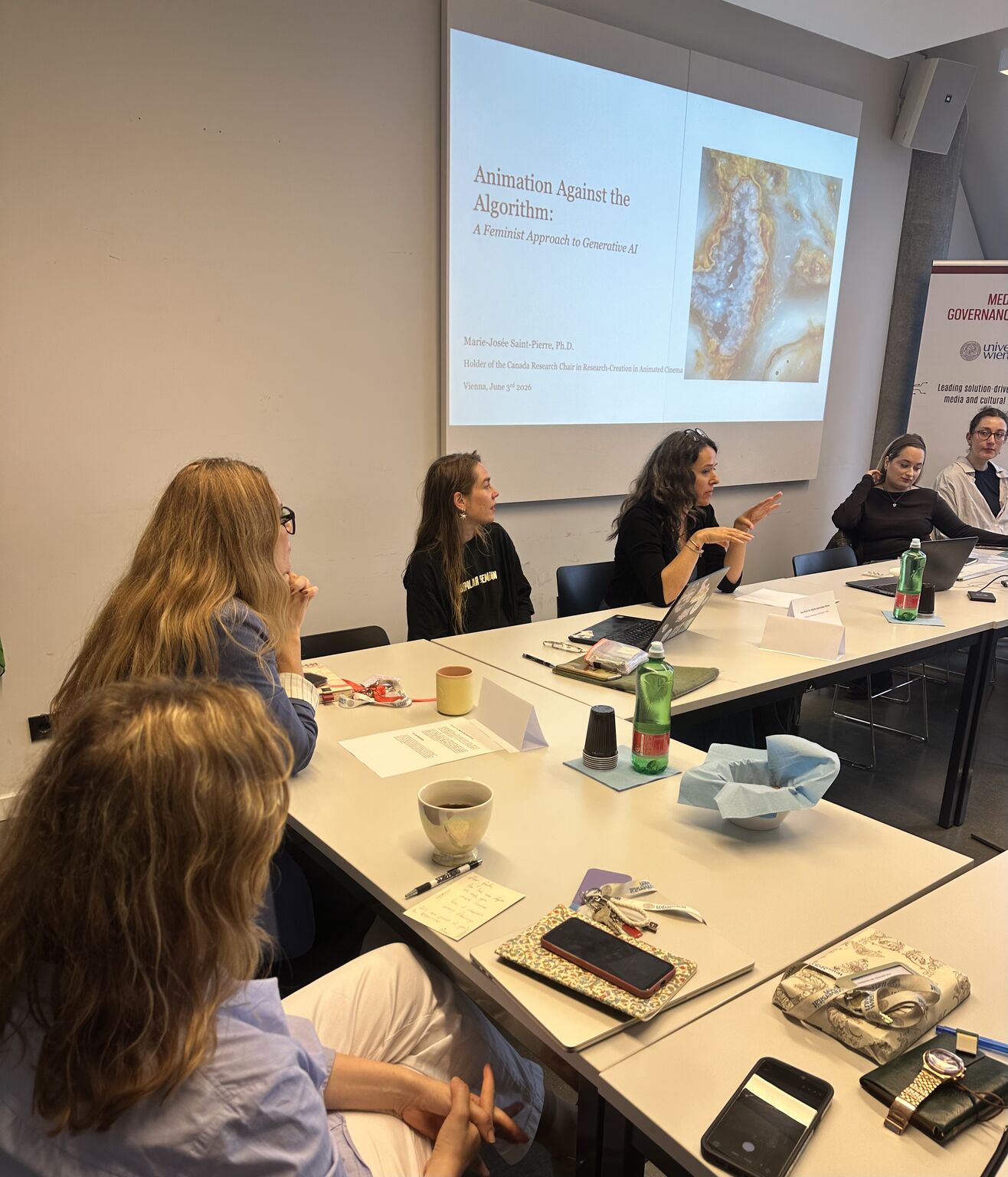
On 3 June, the Media Governance & Industries Research Lab hosted a guest lecture by Prof. Marie-Josée Saint-Pierre (Université Laval), Animation against the algorithm: a feminist approach to generative AI, followed by an intervention from Lisa Heuschober, Co-Director of the Tricky Women Tricky Realities International Animation Film Festival in Vienna. The talk sat alongside the Horizon Europe projects Anima Mundi and REBOOT.
The lecture’s strongest material is empirical and worth establishing up front, because the framing language (“disturb,” “parasitise”) promises more than the practice delivers, while the practice itself delivers something more concrete than the language suggests.
The stance and its theory
Saint-Pierre’s starting position is a refusal of the idea that generative AI is a neutral tool. On her account it amplifies pre-existing structures of domination along lines of gender, race and class. The framing draws on three traditions that genuinely do address the material conditions of these systems, not only their outputs: situated knowledges (all knowledge is partial, embodied and located), data feminism (data and models are never neutral, and algorithms concentrate the conditions of their making), and critical AI studies (algorithmic harm is structural rather than incidental). This is a stronger theoretical base because it locates the problem in how the systems are built and trained. From this she advances a deflationary claim about the technology: generative models produce nothing strictly new, but recompose existing material according to statistical probability. The output, she argues, is drawn from a “toxic visual archive” in which the feminine has already been reduced to a visual archetype.
The experiment, not the tool
The centrepiece is her own AI-generated short, La Pornographe (roughly three minutes, completed at the end of February and since selected for some twenty AI film festivals). Crucially, she frames it not as an attempt to improve the technology but as an experimental lab, a way of probing what these systems do when asked to represent gendered bodies.
This framing matters, and it is more honest than the manifesto language around it. Animation, she notes, was a site for staging fantasies about gender and sexuality long before generative AI; the medium has its own history of reinforcing patriarchal norms. What generative AI adds is multiplication of a single ideal type (white, thin, cisgender) at scale.
The diagnostic findings are the most valuable part of the lecture because they are concrete and, in principle, checkable:
- Prompting for the “essence of womanhood” returned juvenile figures, suggesting the model’s latent space anchors womanhood to youth.
- A request for “sensual women’s legs” had high-heeled shoes added unbidden, the system treating a specific cultural marker as a built-in component of female sensuality.
- Content moderation was applied asymmetrically: an artistic representation of femininity was flagged under content policy, while an equivalent representation of masculinity (beard, exposed muscular torso) was generated without objection. Her summary, femininity is filtered, masculinity is generated, is a precise way to put it.
- A request involving a woman’s breast was refused, then fulfilled when “woman” was swapped for “human.” The trigger was the gendered noun, not the anatomical content.
Her conclusion is that these systems operate on a binary with respect to female sexuality: they either produce the hypersexualised image or refuse the request outright, with little in between. Her own response was to work around the binary through organic and mineral metaphor, “geode-vulvas” and similar abstractions that the filters do not recognise.
Questions the lecture opens up
The diagnostic work is the lecture’s real strength, and it also points naturally toward further questions, less as weaknesses than as the directions in which the project could grow.
- Generative model behaviour is not stable. It shifts across versions and prompts, so the same request can yield different responses over time. Longitudinal testing of widely used language-model services has found that the performance and behaviour of the “same” system can change substantially over short periods, including on sensitive and safety-adjacent prompts; by extension, this makes any single snapshot of moderation behaviour difficult to generalise (Chen et al., 2024).
- The “woman versus human” finding is, of course, striking, and it chimes with what journalistic audits of commercial content filters have shown elsewhere. A Guardian investigation of the moderation tools sold by Google, Microsoft, and Amazon found that these classifiers consistently rate images of women as more “racy” or sexually suggestive than comparable images of men, an effect strong enough to suppress the reach of women’s bodies in everyday and even clinical contexts (Schellmann & Mauro, 2023).
- Statistical recomposition is real but partial. Retrieval-based audits comparing generated images against their training data show that, while most outputs cannot be matched to any single training image, diffusion models (including Stable Diffusion) also replicate identifiable content in a detectable subset of cases (Somepalli et al., 2023).
- The distribution of what gets produced is nonetheless skewed toward dominant types. Large-scale analysis of text-to-image systems shows that ordinary prompts reliably reproduce and amplify demographic stereotypes, and that this skew persists even when users or institutional “guardrails” attempt to counter it (Bianchi et al., 2023)
- That is not a flaw in the method so much as the central difficulty of the whole project: how an individual artist can do more than route around a system they cannot rewrite. The five principles of a feminist ethics of AI animation that she proposed seem aimed at precisely this gap, moving from diagnosis toward something more prescriptive, though the notes here are too brief to assess them.
The festival as counterweight
Heuschober’s contribution shifted the register from the individual artwork to infrastructure. In her account, Tricky Women Tricky Realities exists because of invisibility. Work by women and genderqueer animators was being made but not seen, and so the festival’s role is partly archival and retrospective, granting the visibility and acknowledgement that the field itself withheld. This is a more durable form of feminist practice than anything that happens inside a single image. Where the artwork can only diagnose a bias lodged in a model no individual can alter, the festival builds a standing institution (a record, an audience, a route to recognition) that depends on none of the platform affordances or moderation policies it implicitly critiques. Running annually in Vienna since 2001, it is less an intervention into the system than a parallel one, set deliberately outside it.
What to take from it
The lecture’s lasting value is diagnostic. The prompt experiments are a concrete, communicable demonstration of the ways in which commercial generative systems encode and police gender, and that is worth more than the harder-to-cash-out language of subversion wrapped around them. The open question (the one neither the artwork nor the talk resolved) is what, if anything, carries over from documenting these asymmetries to changing the systems that produce them. The artist can surface the bias and route around it; whether that pressure ever reaches the model is a different problem, and an unsolved one.
Toward a governance response
If that pressure is to reach the model, it is unlikely to do so through individual practice or curatorial counterweight alone. Both treat the symptoms while the cause remains infrastructural. The more plausible lever is media governance, shifting the burden from artists and audiences onto the systems themselves. Three moves follow from the evidence already in view. Because internal “guardrails” demonstrably fail to prevent stereotype amplification (Bianchi et al., 2023), mitigation cannot be left to platforms’ discretion. It calls for mandated, independent algorithmic auditing with vetted-researcher access, of the kind the EU Digital Services Act’s systemic-risk and data-access provisions begin to enable. Because moderation classifiers are opaque, companies withdrew the public testing interface once the “raciness” scoring was scrutinised (Schellmann & Mauro, 2023), transparency duties should extend to the classification criteria themselves, with notice and a route of appeal for users, since shadowbanning works precisely by being invisible. And because a given system’s behaviour drifts substantially over time (Chen et al., 2024), compliance cannot be a one-off. Governance has to be continuous, treating content moderation as an ongoing site of public accountability rather than a private setting. None of this rewrites the model for the artist, but it is the register in which the documented asymmetries could actually become contestable, auditable, and correctable, which is the step identified after attending the lecture.
This blog post was written as part of the Horizon Europe project ANIMA MUNDI (Project ID #101178027) at the Media Governance and Industries Research Lab. For more information regarding the project, please visit the project website.
References
Chen, L., Zaharia, M., & Zou, J. (2024). How is ChatGPT’s behavior changing over time? Harvard Data Science Review, 6(2). https://doi.org/10.1162/99608f92.5317da47
Schellmann, H., & Mauro, G. (2023, February 8). ‘There is no standard’: Investigation finds AI algorithms objectify women’s bodies. The Guardian. https://www.theguardian.com/technology/2023/feb/08/biased-ai-algorithms-racy-women-bodies
Somepalli, G., Singla, V., Goldblum, M., Geiping, J., & Goldstein, T. (2023). Diffusion art or digital forgery? Investigating data replication in diffusion models. In Proceedings of the IEEE/CVF Conference on Computer Vision and Pattern Recognition (CVPR) (pp. 6048–6058). IEEE. https://doi.org/10.1109/CVPR52729.2023.00586
Bianchi, F., Kalluri, P., Durmus, E., Ladhak, F., Cheng, M., Nozza, D., Hashimoto, T., Jurafsky, D., Zou, J., & Caliskan, A. (2023). Easily accessible text-to-image generation amplifies demographic stereotypes at large scale. In Proceedings of the 2023 ACM Conference on Fairness, Accountability, and Transparency (FAccT ’23) (pp. 1493–1504). Association for Computing Machinery. https://doi.org/10.1145/3593013.3594095



Leave a Reply