by Simon Haslauer
In recent years, video games have increasingly been accepted in the classroom as tools of education, with the hope that game logics like immersion, competition, progress and co-operation increase the motivation of students and favour the learning progress. The term gamification describes a similar phenomenon: the use of game-like elements, designs or mechanics to create ludic – playful – experiences in fields outside the realm of video gaming or analogue gaming.
Bearing in mind the discourses of serious games and gamification, the GAMEHEARTS team organised the “Participation and creativity in video gaming” workshop as part of Vienna’s Kinderuni (Children’s university) in July 2024, using game-like elements in facilitating discussion about video games while staying in the physical realm.
Educating young “Cyberheroes”
With the GAMEHEARTS project having kicked off in January 2024, this was the first opportunity for the GAMEHEARTS team to participate in the Kinderuni – one of the largest children’s universities in Europe with seven Viennese universities opening their doors to children between seven and twelve years for two weeks. With two fully booked workshops, offered in both English and German language, these interactive sessions on “Participation and Creativity in Video Gaming” created a thoughtful and playful learning environment where almost 40 children between nine and twelve years explored the value of teamwork in gaming spaces, learned essential strategies for staying safe while navigating online gaming communities and engaged with the concept of digital citizenship.
A “digital citizen” is understood by the Council of Europe as “someone who, through the development of a broad range of competences, is able to actively, positively and responsibly engage in both on – and offline communities”. Through applying age-appropriate interactive teaching methodologies, the workshop tried to not only teach about the concept of digital citizenship but also create an environment that gives children the tools to be and grow into responsible citizens – online and offline. The course addressed this by both using an interactive presentation and letting the kids learn about safety challenges online through quizzes designed as adventure games.
As a quick warm-up, the workshop started with a discussion about the children’s favourite video games and what they like the most about gaming as a whole. While the topics discussed did include healthy gaming habits, such as sticking to age-appropriate gaming contents, some of the children spoke up about their use of games usually only allowed for older children. The workshop facilitators were careful to not shame potentially harmful behaviour by using a participant-centered learning approach, focusing on the participatory, creative and co-operative potentials of gaming.
Using an interactive presentation with videos, quiz questions and always space for discussion, the kids learned about the historical development of early video gaming. The GAMEHEARTS team then again opened the floor for the children’s opinions, accompanying the presentation about healthy gaming habits and responsible behaviour in video gaming – including the protection of privacy, ethical behaviour in gaming chats and the concept of digital citizenship.
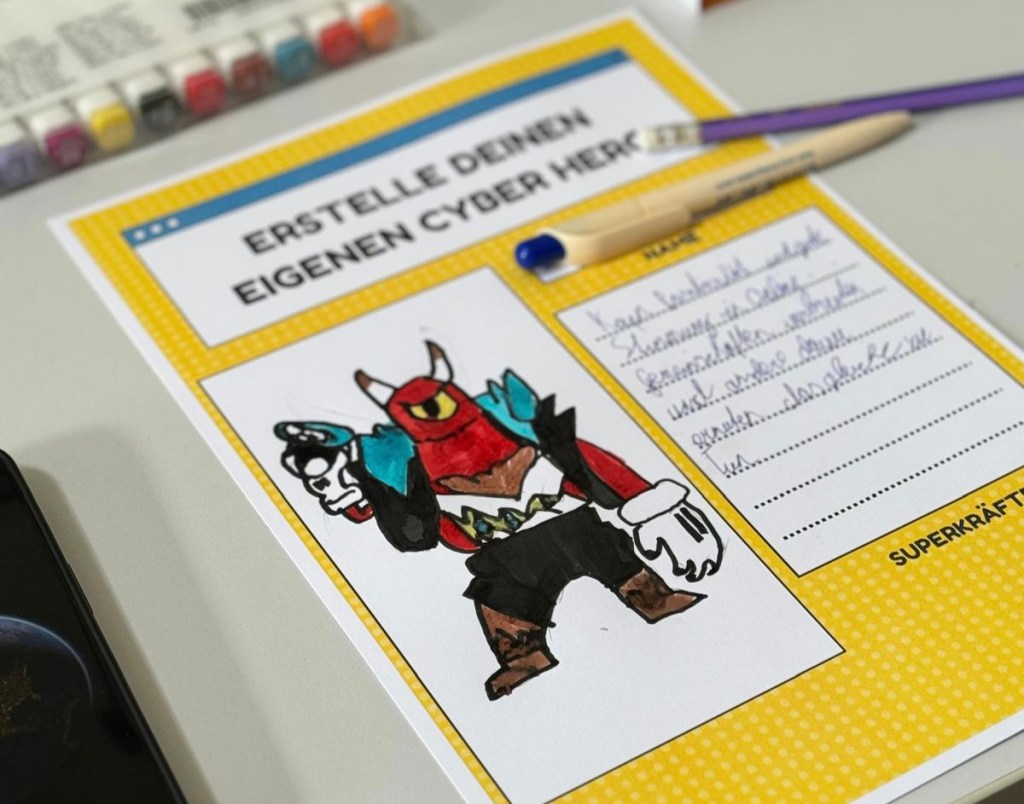
Likely the most exciting part of the workshop was the so-called “Cyberheroes” offline game simulation: the children had the chance to design their own superhero character, giving them superpowers that helped them navigate their way through “Cyberworld”. Equipped with powers like privacy guardian, friendship builder or time manager, the young participants had to collaborate and combine their cyber powers to be perfectly able to master the tasks and challenges the Cyberheroes were faced in a final role-play adventure game.
Young citizens – both on – and offline
It is common knowledge that young people are increasingly spending their time online, creating bonds and interacting with friends and strangers alike. And while digital spaces, used for gaming or otherwise, can facilitate connectivity and self-expression, they also expose children and young adults to risks such as cyberbullying and invasion of privacy. With online technology reaching into almost all areas of life and age groups, it is all the more important to realise the vulnerable position of young citizens and make sure that their translates into the digital world.
GAMEHEARTS’ workshop aimed to use interactive and collaborative activities to translate common rules of conduct from the real world into digital gaming spaces but also use the strengths of gaming to enhance and integrate teamwork and social interaction. Because in times like this, the digital and physical realm cannot be thought of one without the other.
The GAMEHEARTS team wants to thank everyone involved in creating and conducting this workshop and especially give thanks to the team of Kinderuni, that has created this space for children to visit universities and engage with science and research for over 20 years.
References
Council of Europe. (2019). Digital citizenship education handbook. Being online. Well-being online. Rights online. https://rm.coe.int/digital-citizenship-education-handbook/168093586f
Ofosu-Ampong, K. (2020). The shift to gamification in education: A review on dominant issues. Journal of Educational Technology Systems, 49(1), 113-137. https://doi.org/10.1177/0047239520917629
Seaborn, K., & Fels, D. I. (2015). Gamification in theory and action: A survey. International Journal of human-computer studies, 74, 14-31. https://doi.org/10.1016/j.ijhcs.2014.09.006
Simon Haslauer is a Research Assistant at the University of Vienna’s Media Governance and Industries Lab.
Disclaimer
This blog post is part of the ‘Dissemination, Communication, Exploitation and Long-term Impact’ activities organized under Work Package 7 of the GAMEHEARTS (Games, Heritage, Arts, & Sport: the economic, social, and cultural value of the European videogame ecosystem) project. GAMEHEARTS (https://gamehearts.eu/) has received funding from the European Union’s Horizon Europe Research and Innovation programme under Grant Agreement No. 101132543. This publication does not reflect the views of the European Union and is encapsulated within the project.
 Media Governance and Industries Lab Blog
Leave a comment