by Angeliki Chatziefraimidou
The following blog post was originally published on The Reboot Project website.
In recent years, academic interest has focused on informal settings such as workshops, extracurricular activities, and projects on children and filmmaking that inspire and encourage learning and creativity. Studies have found that engaging children in video and film production boosts their creativity and improves their understanding of complex concepts. For instance, Leung et al. (2020) found that in the video workshop they organised, children can experiment with professional equipment from a young age and use “epistemic play” to explore and understand new ideas. Similarly, Drotner (2020) highlighted the benefits of filmmaking outside school for children ages 6 to 16, underscoring the importance of collaboration, praxis-oriented learning and semiotic dialogue in the filmmaking process. Furthermore, during the Play Observatory project they organised, Cannon et al. (2024) showed how informal media creation, such as filmmaking and animation, increased children’s creativity and media literacy, and became an important post-pandemic educational component. These studies emphasise the value of educational filmmaking activities to empower children to express themselves and develop their skills. Aligned with the studies, the REBOOT project team held a workshop for children aged 10 to 12 in Vienna at the Children’s University on July 12, 2024 with the title “3,2,1…and action!”. The Children’s University has been offering research experiences for children since 2020. Children can explore topics that interest them from a variety of over 400 contributions designed by scientists from several universities. Our workshop focused on filmmaking was aiming to:
- Raise interest among young people in the film industry.
- Foster their creativity by enabling them to create their own stop-motion videos.
- Educate them about the process and tools required for filmmaking.
- Provide an opportunity for children to learn about different professions in the industry and try out various roles in real filmmaking practice.
The workshop began with an introductory game where the children shared their names and favourite films. By passing the ball to each other, the children felt more comfortable and connected as they discovered common interests. The next activity involved matching different professional tasks with the corresponding filmmaking professionals and categorising them into preproduction, production, and postproduction phases. All children were involved in assigning the jobs to the professionals and showed great interest in the classification into the production stages. The children were surprised by the variety of occupational groups and very motivated to present their own profession. This activity was very interactive as everyone was careful to match their card to another participant’s card. The activity had an important informative and educational aspect. For example, one girl was confused but also surprised when she matched the job of film producer to the production phase and after the discussion realised that this is actually part of the pre-production phase. Following this, the invited professionals introduced the eight steps of filmmaking and provided two additional short training sessions on camera angles and lighting, where children could see in real life the interaction and combination of cameras and lights. Children were very interested asking questions and giving examples from their own video projects.
The participants were then divided into three groups to create their own films. Each group received support from researchers and professionals, along with a booklet that guided them step by step in making decisions about selecting characters, developing plots and creating the storyboard. The children, working in teams, had to complete the entire process of making stop-motion videos on their own, while the role of the professionals, researchers and assistants was mainly to organise and support them. Based on their talents, children assumed the responsibility of various tasks, such as choosing characters, defining the title and creating prompts. All groups had access to materials corner stocked with sceneries, Playmobil figures, animals, Lego box and other available materials.
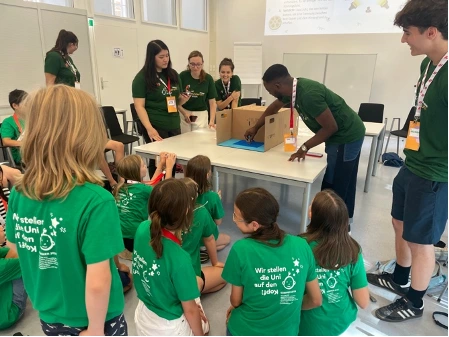
Upon completing the editing, it was “movie time”, where participants had the opportunity to watch all three stop-motion films they produced. Children were very excited watching their own productions. Finally, the participants received certificates and small gifts featuring the animal and figures they had used in their films. In their feedback, the children expressed an interest in the film industry, with over 20 participants indicating a desire to pursue a profession in this field. The majority already had some experience in filmmaking, having shot videos on their own, either with friends or with parental support. Participants shared new things they learned from the workshop, including “I learned about the three-lights effect” (boy), “I learned that the process of production starts before the actual production phase of the film” (girl), and “I didn’t know that so many people work to make a film” (girl). Although the children found the teamwork process challenging due to the variety of opinions and roles, they also found it exciting.
The workshop had a profound contribution to the aim of the REBOOT project at the enhancement of the competitiveness of the European film industry, that can be achieved by: 1) Encouraging labour mobility; (2) Investing in education; (3) Boosting productivity (Esposito & Tse, 2012, p. 81). Through this workshop children had an educational experience of the process, equipment such as mobiles or computers and international young professionals of the film industry, having the opportunity to explore the different areas of filmmaking by themselves. Getting knowing the variety of the available professionals, sharing the same passion for film making and fostering their creativity and aspirations for the future.
Working with children required careful ethical considerations. We ensured that children’s participation was entirely voluntary and conducted the workshop with them, not at them. Throughout the workshop, we were mindful of the power dynamics between adults and children, and between professionals and children. We always emphasised child-friendly communication and used language appropriate to their developmental stage.
This workshop was an important communication of the REBOOT project demonstrating how early exposure to filmmaking skills can spark young people’s interest and creativity and potentially inspire them to pursue future careers. The workshop not only provided hands-on experience with professional tools and processes, but also educated participants on the diverse roles in the film industry. By involving children in such activities, the REBOOT project supports the development of a skilled and passionate young generation, which is vital for the continued growth and competitiveness of the European film industry.
Finally, we want to thank the people running the workshop, who consisted of four researchers (Sarikakis K., Chatziefraimidou A., Jüngst J. and Ramadani G.), two film industry professionals (Permana C.J. and Zogo Y.S.C.), two assistants (Bismarck-Sarikakis K.G. and Lesi S.) and one photographer (Schröder L.).
References
Cannon, M., Potter, J., Olusoga, Y., & Cowan, K. (2024). Lessons from the Play Observatory: re-imagining learning through film-making and transludic practices in children’s pandemic play. Education 3-13, 52(1), 61-77.
Drotner, K. (2020). Children’s digital content creation: Towards a processual understanding of media production among Danish children. Journal of Children and Media, 14(2), 221-236.
Esposito, M. & Tse, T. (2012). European competitiveness: An oxymoron?. Harvard Business Review Italia, 3, 78-84.
Leung, S. K., Choi, K. W., & Yuen, M. (2020). Video art as digital play for young children. British Journal of Educational Technology, 51(2), 531-554.
Angeliki Chatziefraimidou is a PhD candidate at the University of Vienna, Department of Communication. After many years working in education, she is a research assistant at the University of Vienna, specialising in children and media.
Disclaimer
This blog post is part of the ‘Dissemination, Outreach, and Engagement’ activities organised under Work Package2 of the GAMEHEARTS: Games, Heritage, Arts, & Sport: the economic, social, and cultural values of the European video game ecosystem project. This project has received funding from the Horizon Europe program of the European Union under the Grant Agreements No 101132543 and No 101029543. It does not reflect the views of the European Union and is a publication encapsulated within the project.
 Media Governance and Industries Lab Blog
Leave a comment