by Janina Jüngst
The following blog post was originally published on The Reboot Project website.
Film festivals have emerged as a crucial platform for acknowledging the talent and contributions of women filmmakers, who have historically been underrepresented in the industry. The Cannes Film Festival in 2018 highlighted the gender disparity by featuring a gathering of eighty-two female filmmakers on the red carpet, representing the small number of women who have been given the opportunity to participate since the festival’s inception in 1946, compared to thousands of men. This powerful demonstration shed light on the significant challenges and barriers that women face in the film industry. However, film festivals also offer positive indications of women’s achievements, particularly in Austria. These events have provided a valuable stage for numerous talented Austrian female filmmakers to exhibit their work to a broader audience and gain international acclaim. The accomplishments of these women serve as both inspiration and proof of the creative potential within the Austrian film industry. Furthermore, studies, such as the Austrian Film Institute’s Film Gender Report have revealed that Austrian female filmmakers win more awards at film festivals than their male counterparts (Zappe-Heller, 2023).
Gender incentives as a bonus for film makers
To promote gender diversity in film projects, a bonus of 30,000 Euros is offered if the team includes female professionals in various positions such as production, directing, screenplay, and more. Points are assigned to each position, and once a score of 50 points is reached, the Film Gender Report is fulfilled, and the bonus is granted automatically. These incentives aim to encourage the inclusion of women in the industry. However, filmmakers are eager to secure the highest possible funding for their projects, so they often take a gamble on the extra money from gender incentives, even if the market cannot provide the necessary conditions by fully booked female film makers. As a result, the film team faces significant pressure to meet all the funding requirements right from the beginning.
Leaky pipeline also in the creative industries
Current studies in Austria reveal that the film industry is not immune to the “leaky pipeline” phenomenon, which refers to gender disparities in professional careers, particularly in higher positions (Zappe-Heller, 2023). The representation of women decreases as positions become more senior, salaries increase, and decision-making power grows. While the gender distribution in entry-level positions may be more balanced, women face significant obstacles in their career progression and tend to “get lost” along the way. However, in recent years, studies show that in terms of promotion, women have a slight superiority here in newcomer films, which are the first or second works of female or male directors (Zappe-Heller, 2023). This suggests that many young women are drawn to the film industry, but it remains uncertain whether this trend will persist in the future and requires further evaluation. Nevertheless, there is a significant shift in proportions, as more men than women, especially those without relevant education, work in the industry. Women also receive less than 30 per cent of the funding from the Austrian Film Institute, highlighting the unequal distribution of resources (Zappe-Heller, 2023). Additionally, women’s family planning and childcare responsibilities pose specific challenges that can act as barriers to their participation in the film industry. However, measures such as on-set childcare and support from funding institutions and producers are being implemented to address these challenges and ensure that women can pursue careers in the film industry without hindrance.
Gender Incentives as European Model? – Similar Situations
When considering the application of the Austrian model of gender incentives to a wider European context, it is important to address both the implementation of such measures and the underlying issue of resource distribution in the industry. Women are notably underrepresented, especially in directing roles, emphasizing the need for effective measures to promote gender equality.
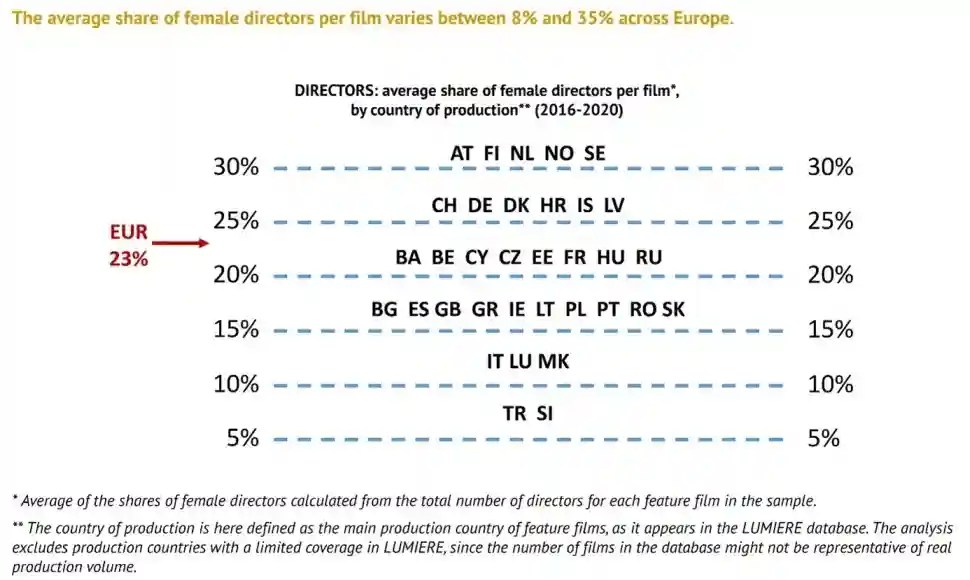
According to the provided chart, Italy, despite being a prominent film industry in Europe, has one of the lowest proportions of female directors. The European Union average stands at 23%, indicating the potential for improvement in achieving gender balance. Addressing the gender distribution in directorial roles is crucial, especially if plans are being made to implement a gender incentive film funding mechanism. The challenges faced by the Austrian film industry, where male filmmakers support gender equality but struggle to find available female collaborators who are already occupied, are also relevant in this context.
The European Audiovisual Observatory studied the percentage of female-occupied roles in film productions in Europe from 2016-2020. It indicates that significantly fewer females are involved in film projects than males. Among directors, only 21% are female and women have only 38% of the leading roles in film projects (Simone, 2021).
Empowerment measures
The Austrian context demonstrates effective empowerment measures for women in the film industry, including the gender incentive, women-exclusive workshops such as Pro:Pro, women film festivals like “Tricky Women,” and competitions like “If she can see it – she can be it.” To further promote gender empowerment and retention of women in the industry, increased efforts are needed. Encouraging a shift in mindset among men in the industry is also important. Additionally, improving the film industry as a whole to create more opportunities for everyone involved would be beneficial.
References
Simone, P. (2021). Female professionals in European Film production. European Audiovisual Observatory.
Austrian Film Institute. (2021). Second Austrian Film Gender Report.
Janina Jüngst is a PhD Candidate in the Communication Department at the University of Vienna.
Disclaimer
This blog post is part of the ‘Dissemination, Outreach, and Engagement’ activities organized under Work Package 7 of the REBOOT: Reviving, Boosting, Optimizing, and Transforming European Film Competitiveness project. This project has received funding from the Horizon Europe program of the European Union under the Grant Agreement No 101094769. It does not reflect the views of the European Union and is a publication encapsulated within the project.
 Media Governance and Industries Lab Blog
Leave a comment