By Michael Cserkits
The old proverb in the journalistic sphere: “Only bad news are good news” has to be reconsidered due to the latest events that happened just some days ago in Mali. Some might ask: Where is Mali? What the hell happened there? And, most important: What has Austria to do with it? If you are an Austrian citizen, you may not be aware that actually, right now, Austrian soldiers are deployed to Mali in order to train the local armed forces. But let us start a little bit before this military adventure began and look at it from a Military Sociology perspective.
Mali, as an Western African nation, is what some authors call a “zone of negative peace” (Thies 2010, p. 391). This negative peace can only exist due to the fact that all West-African nations are more concerned with internal conflicts than projecting their power to their direct neighbors. Again, Mali has always been a case example for political theories that tried to prove such theories. But the problems on the ground are more complex then articulated in an theoretical framework and their effects are wider than some might think.
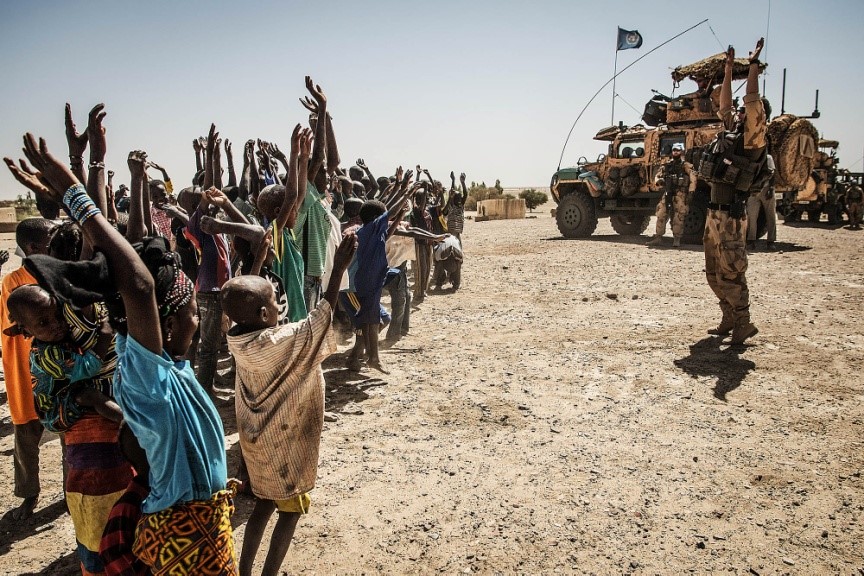
In the biggest West African nation, several conflict layers appear at the same time. The most obvious was the religious one with its climax in the “announcement” of the state Asawad by Tuareg militia and the conquest of Timbuktu. This conflict was claimed to be ended by a French military intervention and the withdrawal of the Tuareg. As a matter of fact, they were replaced by other radical islamic groups. Even if this conflict received at least some echoes in the European media, it’s core was never to be discussed. At the very beginning, and long before the idea of an islamic state called Asawad was born, nomads and the Malian government clashed together on a regular basis. A certain rhythm of forth and back regarding individual freedom, compared with classic tribal interests and a lack of such new inventions like “borders” or “citizenship” (see Salzman 1974) had just intermingled with a religious movement that gave the whole situation enough power to get out of control. But again, these nomadic structures where not necessarily predestinated to be the vessel of extreme ideologies.
Where “… honor comes with victory and shame comes with defeat“ (Salzman 2008, p. 106) exists a never-ending competition, where there can only be winners and losers (as there is no honor found in retreat, defeat or being the victim). The feeling of shame coexists with the next conflict layer, the ethnic dimension. As nomads, Tuareg tribes had been underrepresented in the Mali government and administration. Additionally, there is a pure economic conflict, with more or less rich farmers in the south and poorer tribesmen and livestock growers in the north.
After now knowing that there are at least five intertwined conflict layers (the religious, the nomadic, the cultural, the ethnic and the economic), some might think that the community of states may act due to the formidable amount of problems that arose in the shed light of the distinct conflicts. And, of course, these actions had to be coordinated, consolidated and constructive. Well, if we look at the current situation, we can identify at least three international key players with distinct aims. First, there is MINUSMA, an UN-led mission started in 2013 with the overall aim to stabilize the area. Then, we have the European Union Training Mission in Mali (EUTM MALI), which started like MINUSMA in 2013, after the retreat of the Tuareg rebellion. Beside training higher military staff one of the main aims is to train the average Malian soldiers in “European” ways of dealing with war. And then, beside the international track, we have Opération Serval, a French military intervention which has no offical website and serves national interests. It may be noteworthy that the ESS (European Security Strategy) highlights the importance of stabilizing regional conflicts without mentioning a specific area of operation. Additionally, by supporting Combined Training Missions like the ongoing in Mali, the Common Secure and Defense Policy could gain more arguments for close ties between different armies.
Leaving aside the huge impact of three different military campaigns on the Malian society, we now came back to the primary question: What has Austria to do with it? Of course there is a multilateral agreement between the European Union and the Austrian government and all soldiers that are sent abroad are so on a legal basis. But be honest: Did you know it? If not, you’re in good company. For example: On the 15th April 2018, a suicide attack killed one soldier from MINUSMA and wounded a dozen of other international personal. Al Jazeera gave the story a whole page on it’s Africa section, the Daily Mail (UK) gave it a headline in the International Section . BBC reported with a middle length article on it’s African section and even the Washington Post reported a small article on the African section. And Austrian media?
Der Standard just made a small note on it’s international page and gave it’s headline to the funeral of Nelson Mandela and the ongoing Syrian crisis. The Kurier didn’t report about the incident as well as the Krone, the biggest Austrian Newspaper.
What can we learn from this small example? First, we have seen that even the simplest conflict has many layers, most of them not publically articulated (despite discussed). It is a phenomena that Connell (2007) already stated in her “World Sociology”, where she articulated the lack of learning mechanisms in most western countries. Due to the long tradition and historical backup as empires or dominions, most northern regions of the world gave little to less value about facts and findings from the south. In contradiction, the information and knowledge created in the global north is at itself a value, and as a value it is accumulated and controlled. Information empowers, and those who are in control of the information flow can adjust the power relations, in small as well as in big sizes. The obvious information gap – meaning the lack of information or the projected non-talk about certain issues – creates a specific way of how we see the world. By transferring our whole trust towards newspapers or digital media, we have to be aware that still there is a huge selection mechanism working behind the scenes with one simple goal: Deciding what to tell us and what to leave aside.
Literature:
Godlee, Fiona, Richard Horton and Richard Smith. 2000. Global information flow Publishers should provide information free to resource poor countries In BMJ, Vol. 321, Issue 7264, pp. 776–777. Online-Ressource: https://www.ncbi.nlm.nih.gov/pmc/articles/PMC1118595/
Thies, G. Cameron. 2009. National Design and State Building in Sub-Saharan Africa In World Politics, Vol. 61, No. 4, pp. 623-669.
Salzman, Philip Carl. 2008. Culture and Conflict in the Middle East. Humanity Books: New York.
Salzman, Philipp Carl. 1974. Tribal Chiefs as Middlemen. The Politics of Encapsulation in the Middle East. In Anthropological Quarterly, Vol.47, 1974; pp. 203-210.
Connell, Raewyn. 2007. Southern Theory. Social Science and the Global Dynamics of Knowledge. Cambridge: Polity Press.
La Constitution du Mali. DECRET N°92-0731 P-CTSP PORTANT PROMULGATION DE LA CONSTITUTION. http://unpan1.un.org/intradoc/groups/public/documents/CAFRAD/UNPAN002746.pdf
Aljazeera. 2012. Tuaregs claim ‘independence’ from Mali. https://www.aljazeera.com/news/africa/2012/04/20124644412359539.html
Harding, Luke and Willsher Kim. 2013. French and Malian forces approach Timbuktu. https://www.theguardian.com/world/2013/jan/27/french-malian-forces-approach-timbuktu
Washington, Adolphus. 2016. Malian blues: the issue of the Tuareg https://globalriskinsights.com/2016/01/malian-blues-the-issue-of-the-tuareg/
United Nations Multidimensional Integrated Stabilization Mission in Mali. 2018. https://minusma.unmissions.org/en
European Training Mission in Mali. 2018. http://eutmmali.eu/
France24.com. 2017. Map: France revamps military operations in Africa’s Sahel. http://www.france24.com/en/20140508-infographic-france-military-in-africa-sahel-le-drian-mali-chad
Aljazeera News. 2018. Fighters disguised as peacekeepers attack UN base in Mali. https://www.aljazeera.com/news/2018/04/fighters-disguised-peacekeepers-attack-base-mali-180415062009438.html
BBC News. 2018. Mali militants attack bases disguised as UN peacekeepers http://www.bbc.com/news/world-africa-43772363
AFP. One dead, 20 wounded in Timbuktu ‘terror’ attack: official. http://www.dailymail.co.uk/wires/afp/article-5616437/UN-forces-face-unprecedented-attack-Mali.html
Baba, Ahmed. 2018. Mali attack kills peacekeeper, wounds 10 French soldiers. https://www.washingtonpost.com/world/africa/mali-attack-kills-peacekeeper-wounds-10-french-soldiers/2018/04/14/a0ca4b60-4032-11e8-955b-7d2e19b79966_story.html?utm_term=.1a507b149896
APA. 2018. Drei Tote bei Anschlag auf UN-Truppen in Mali. https://derstandard.at/2000014371159/Drei-Tote-bei-Anschlag-auf-UN-Truppen-in-Mali
Kurier. 2018. https://kurier.at/search/mali/date/10/1
Krone. 2018. http://www.krone.at/themen/mali
European Union External Action. 2018. Shaping of a Common Security and Defence Policy. https://eeas.europa.eu/headquarters/headquarters-homepage/5388/shaping-common-security-and-defence-policy_en
European Union External Action. 2018. The EU strengthens cooperation on security and defence. https://eeas.europa.eu/headquarters/headquarters-homepage/35285/eu-strengthens-cooperation-security-and-defence_en
Picture (free to use non-commercial):
 Media Governance and Industries Lab Blog
Leave a comment