*This blog post is part of the Jean Monnet Chair of European Media Governance and Integration series

By Mario Nottas
Government is a favourite subject among Greeks (who’d expect different in the birthplace of democracy?) Therefore, public broadcasting (PB) is constantly in the public eye, be it in political, journalistic, business or even social circles.
PB underwent a shock, when recently, in 2013, the plug was pulled overnight, by the Samaras conservative government (which in 2015 lost to Tsipras, the current administrator). Many say that two factors expedited this fall. One was the Public Radio &TV shutdown. The other was a sudden, unforeseen (and well-hated) property tax.
Apparently Radio and TV in Greece are constantly under scrutiny, among other reasons, for this: In a deregulated and financially unstable media-scape a good part of the Greek population feels that ERT (Hellenic Radio & TV) is worth having and another good part feels appalled as it is allegedly pretty tolerant with the government and too sophisticated/expensive for a license-paying general audience. Amidst this criticism ERT in recent years managed not only to balance its budget (from deep red) but to the surprise of most, also make a profit. Further, it is regarded as a safe harbour for professional journalists whose trade is being redefined by job scarcity, long work hours and underpayment
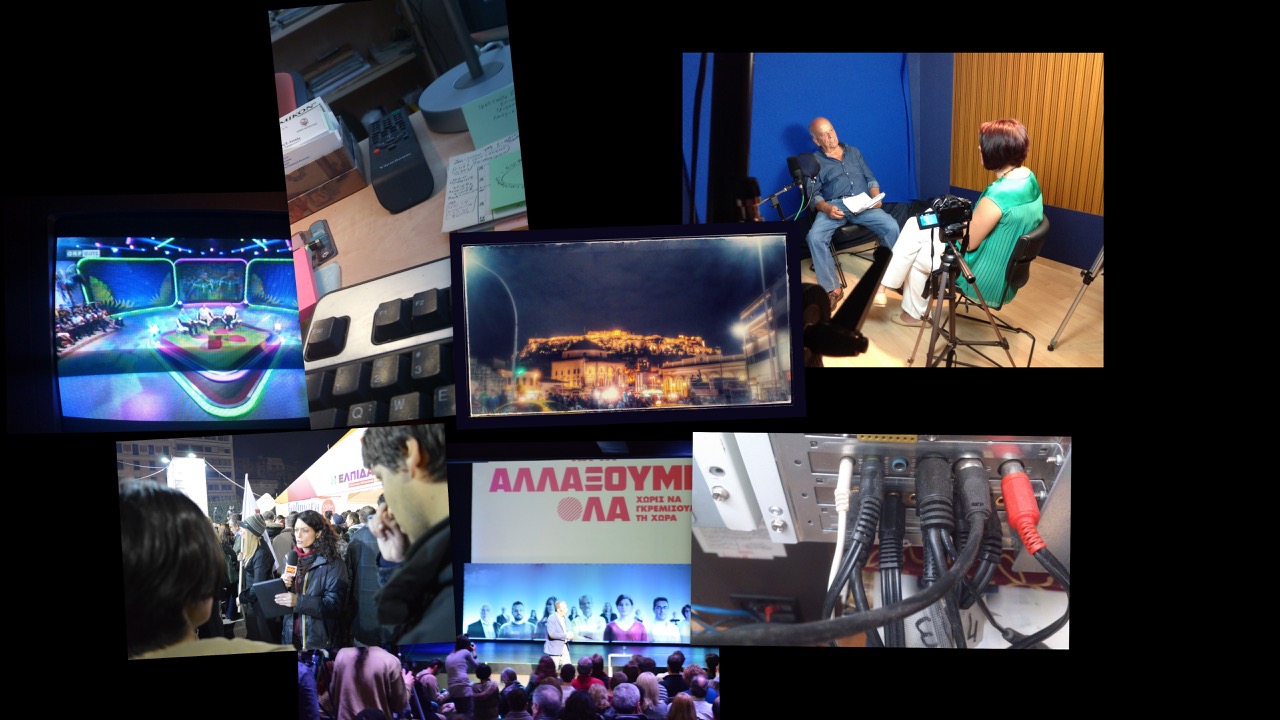
Media attention is not something new in Greece: Amidst the escalating Crisis and a mounting refugee problem, Hellenic headlines have been preoccupied in the last two months with the constitution of the Independent Audio-visual Authority, a real ‘luxury’ for a society that lost about 30% of its GNP, and a good great deal of its self-esteem, within the last six years. The plot thickens when one considers that this is a relatively ‘new’ audiovisual market, that boomed alongside the digital media one in the nineties. From a tightly regulated state monopoly, it rocketed to a totally unregulated ‘free market’, to what it is today: An agreement for a widely accepted and powerful regulatory agency was reached on November 12, 2016, in an effort to finally lay the rules of the land.
The complexity thus far is best shown by an unprecedented procedure. A mixed Parliament committee is currently (late 2016) assigned to investigate (“follow the money”) the thin threads connecting banks to media to political parties. Top media and bank executives, CEOs and journalists have already testified over a streamed live process, offering a wealth of information to future historians, communicators and social scientists.
At this point one would expect the rise of a more universal system of public monitoring and control over this rather complex scene. This was seen before in Greece, i.e. in the late eighties. “Channel 15” was a citizen group, whose actions paved the way for the ‘Media Spring’ of the nineties.
Strangely enough the focus was the other way: An idea was adopted, ingenious in its simplicity and apparently effective. However, it focused on the betterment of Public Broadcasting alone, and not operating media in general.
This novel idea, was to apply citizen monitoring through a “Social Control Council”, formed to ‘supervise’ ERT, report to the Board of Directors and have full access to all aspects of the PB decision making, plus more.
The concept was developed by the “Citizen Interface” service which up to that point only handled calls and mails by usually upset viewers. It suggested that local boards should assume regional public broadcasting supervision. They were to combine members randomly selected from all interested citizens (in a public ballot) and invited NGOs / public benefit orgs, who were to appoint their reps to the Council, directly. A straightforward system would further ensure refreshing this pool, on an annual basis. The Council has been given a large studio to confer in, an electronic unmoderated forum to support the intervals among the monthly meetings, office space, minimum secretarial support and – most importantly- accountability: All proceedings are streamed live, stay on archive, go on written minutes and serve as material for a moderated monthly TV show, called ‘Citizens’, which does well in the ratings, considering its late fringe airtime.
Most importantly: The rules governing these ‘SCCs” (Social Control Councils), are not fixed. Any 11-member sub-group (the SCC full size is 100, and convenes lawfully with a 2/5 presence) can question and re-phrase any or all of the Council’s “constitution”, allowing for an ever-improving internal operation system. This was recently tested in practice, when a five-member party managed to re-orient the Council and its committees, to become horizontally syntaxed – corresponding to each Directorate in ERT’s official management chart. This means in practice that citizens in SCCs have a say on i.e. matters of Program, News, Administration, Technology, and on. They hold accountable the corresponding general directors, converse directly with them and (are to) produce frequent reports. They further internally created a ‘section’ to optimize communication among SSC and ERT on the one hand and the general audience on the other.
Passionate argumentation in physical meetings, as manifested on videos which remain online, adds a democratic aura, referring directly to the ancient ‘Agora’. This allows critics to say that a) the number of participants, and b) the streamlined attention to public media only, already undermines the project.
However, defenders still think that this is a real life pilot – project. If successful it could aid more accountability in the Public Sphere. In this case, it is far beyond public media (or the Public Service agents) that is in question. This concept potentially relates directly to the private sector, involving monitoring coming from ‘below’ in the form of citizen monitoring methods. However, in this case, it is not “NGOs”. It has to do with the possibility of centrally generated Institutions, which shall both encourage the creation of emancipated monitoring citizen bodies, and pre-actively “legalize” their intervention.
This is still just potential. It remains to be seen what the project will be like in a few months from now, and how it will affect Hellenic public life. If successful, it could meet the interest of other Public Broadcasters or regulators around Europe (and beyond), should they find the idea attractive and –hopefully- applicable.
 Media Governance and Industries Lab Blog
Leave a comment