*This blog post is part of the Jean Monnet Chair of European Media Governance and Integration series

By: Robert Braun*
A spectre is haunting Europe – the spectre of post-modern ‘Bonapartism’. Democratically elected governments, especially in post-socialist Europe, are using a mixture of propaganda, indoctrination and repressive apparatuses coupled with anti-refugee rhetoric and political initiatives against refugees catering to the sentiments of non-college-graduate angry white males to keep popular support for their ‘Bonapartist’ rule. In Western Europe the same sentiments are on the rise: fear of a new economic crisis, technological advancement and loss of jobs, fear of refugees and the inability of mainstream governments to tackle the flow, create fertile soil for right-wing ‘Bonapartism’.
Brexit, the potential election victory of extreme-right-wing presidential candidate Norbert Hofer in Austria, the rise of AfD in Germany, anti-refugee right-wingers in the Netherlands or Finland capturing important parliamentary positions may just be the beginning. European leaders should be vigilant and firm. The fall of Europe is not inevitable: it is only happening if politicians, out of cowardice or calculation, shy away from making tough decisions. A federal, politically and institutionally unified Europe with strong, legitimate and democratically elected leadership having a progressive vision may be in a position to make and pass such decisions.
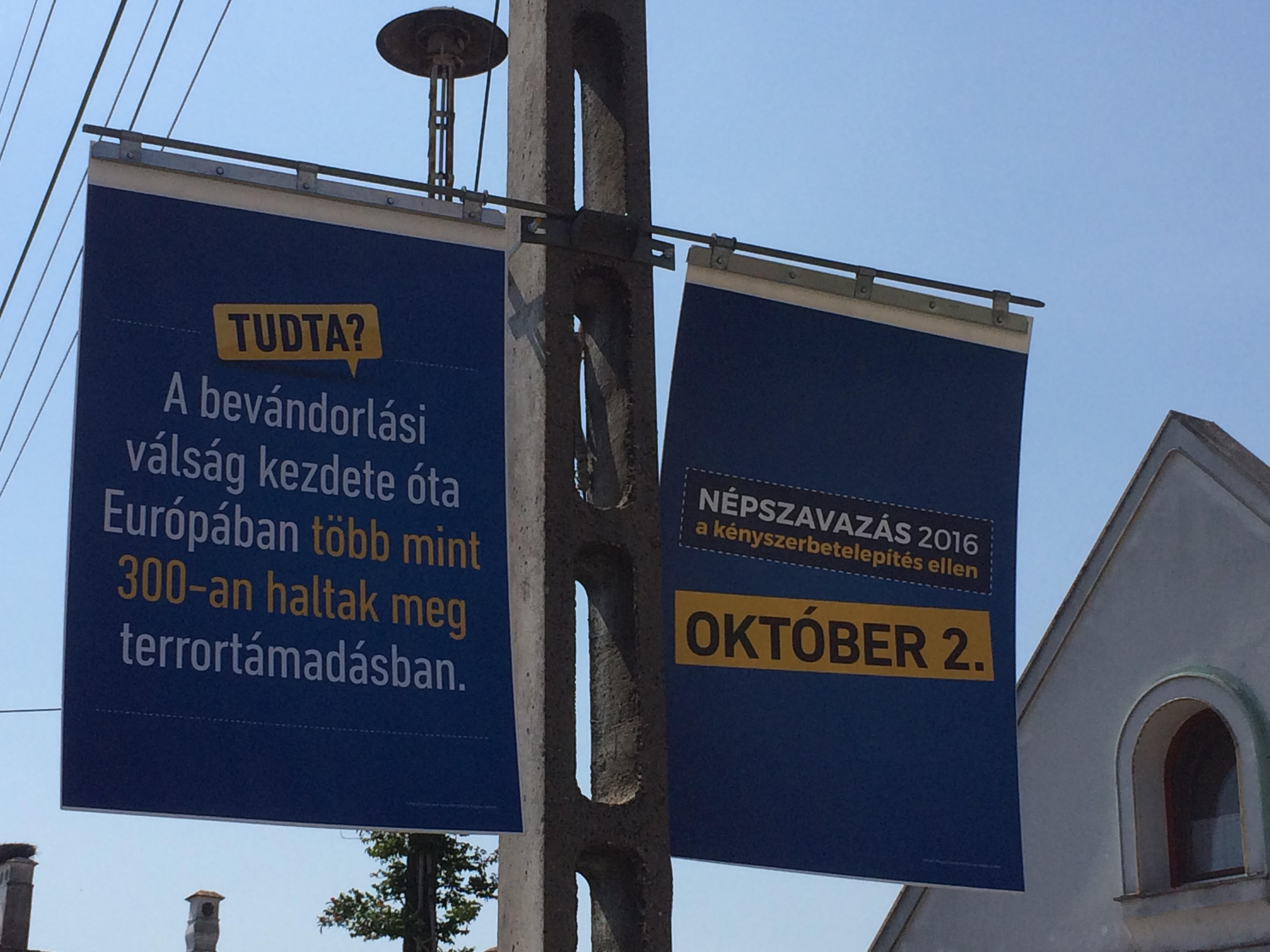
European leaders may look at what is happening in Hungary to understand the depth of the process as well as be reminded of the historical past. The ‘Thirties’ were the ‘Thirties’ only because of the war of the ‘Fourties’ after it. However, it was the cowardice, thoughtlessness and, sometimes, sheer stupidity of the leaders of Europe then to not see what was happening in Germany, Austria, Hungary and Italy at the time. “Those who cannot remember the past are condemned to repeat it,” Santayana famously wrote. That past is happening now. European leaders do not even have to remember: they only have to look and understand.
Here is what is happening:
After the Hungarian government passed a one-party Constitution as well as a gerry-mongered election Law, exercised total control over the media by state capture and a biased regulatory regime, it was time to finally turn to the masses. As Hannah Arendt, the great German-American political theorist, writes: “[O]nly the mob and the elite can be attracted by the momentum of totalitarianism itself; the masses have to be won by propaganda.”[1] The elite (or the ‘influentials’ according to the Dictator’s Handbook) were won in Hungary by systemic corruption and rentierism, the mob by blind nationalism. The electorate must be kept at bay and be prepared for elections in 2018. And propaganda, Fidesz, the governing party in Hungary, knows well. Recently the government initiated a referendum on the European refugee quotas. “It was recognized early and has frequently been asserted that in totalitarian countries propaganda and terror present two sides of the same coin”[2] writes Arendt in her Origins of Totalitarianism. Cities and villages are flooded with government advertising claiming “Did you know? The attack in Paris was committed by migrants” or “Did you know? Since the beginning of the migrant crisis attacks against women increased drastically.” The ‘facticity’ of the texts are fascinating. The ‘did you know?’ tagline turns the claim into fact: some seem to be uncontestable truths while some are predictions that may only be proven wrong in the future. The winner: “Did you know: there are a million people wanting to come to Europe from Libya.” The ‘factical’ tagline is a well-known linguistic tool at work: the factuality of the claim is reinforced by the ‘Did you know?’ intro.
Hungary’s self-proclaimed illiberal democracy has a lot in common with what Arendt saw as the beginnings of totalitarianism. Propaganda, according to Arendt, is the most important instrument of totalitarianism for dealing with the non-totalitarian world. Government PR becomes propaganda when state authorities are demeaned to cogs in the system of totalitarian communication. The National Election Board in Hungary cynically ruled that government advertising cannot be considered biased, something that is prohibited by law during referendum campaigns, since the official campaign period has not even started. The Court of Appeals (Kuria) ruled that “the constitutional requirements of government statements in governmental information campaigns differ from information based on objective facts or data-supported everyday requirements.”
Propaganda then is transformed into indoctrination when the level playing field of actors ceases to exist. The masses are fed with seemingly factual information about refugees (migrants in ‘officialspeak’) in a country where even the non-existent pireans are disliked by 60% of the population. When one walks the towns and villages in Hungary nowadays it is impossible to avoid the anti-refugee government ads. This is the talk in the pubs, this is what people speak about at school, even over Sunday lunch. ‘Migrants’ are the new Jews in a country that sent 600 000 people (Jews and Gypsies) to concentration camps within a period of three months in 1944. Attacks against Gypsies and gays, the two most disliked groups, are on the rise. It is not a political game any more: a generation of Hungarians will grow up with the hatred served to them through all communication channels possible. The advertisement campaign was complemented by 1 minute newsreels during the Olympic and soccer European Cup broadcast every half hour: 3 out of the 4 pieces of news aired in each are about the crimes committed by ‘migrants’. Funny that: the average Hungarian has never seen any refugees. The borders are sealed airtight by fences, the few refugees who get through are duly transported back to their country of entry to the EU. However, there are many against whom such hatred induced by the campaigns can be directed. Anti-immigrant sentiments are over the roof.
Ágnes Heller, the Hungarian philosopher, a frequent critic of the Orban regime, described the present situation in Hungary as “Bonapartism.” It is understood as a political system associated with authoritarian rule usually by a political or military leader ostensibly supported by a popular mandate. Based on what we see on billboards and citylights, on TV and hear on the radio, present day Hungary may be characterized as post-modern Bonapartism: terror and violence is (yet) substituted by propaganda and indoctrination. Orban’s regime is post-modern in as much as its weapons of violence are texts and repressive apparatuses used ‘only’ to support ideological ones. We do see, however, that in traditional Bonapartist regimes, such as Assad’s Syria, Erdogan’s Turkey or Putin’s Russia, propaganda and indoctrination lead to violence and outright repression. The anti-refugee campaign of the Hungarian government is the last wake-up call to all of Europe in a long series of Hungary trespassing the limits of democracy. Bonapartist regimes are enemies of the values Europe was founded upon. It all starts with propaganda and indoctrination and ends with the pictures we currently see on CNN in Aleppo. Present mistakes are tomorrow’s sins. Today we see posters of indoctrination hanging from lamp-posts in the small villages of the back of beyond of Hungary. Posters will go, lamp-posts will stay. European leaders must realize what is happening in their own backyard. The anti-refugee campaign is one of the Chamberlain moments of Europe: to let Orban have his way shows the weakness of the EU as well as the destructive powers of post-modern Bonapartism.
*Robert Braun moved from Hungary to Austria with his family a year ago drifting from the debris of a once hopeful polity. Besides his academic career in Hungary, Robert used to be State Undersecretary for Communications at the Prime Minister’s Office (2002-2004), Senior Adviser to the Prime Minister (2004-2005), and Chief Communications Adviser to the Governor of the National Bank (2009-2012). He is also one of the founders of the leading online content provider in Hungary (1999) as well as the owner of the independent news agency (2011). He is currently Senior Researcher at the Institute für Höhere Studien and Professor of Business Ethics at the Lauder Business School.
[1]Arendt, Hannah (1958). The Origins of Totalitarianism, London: Harcourt Brace and Co., p. 341.
 Media Governance and Industries Lab Blog


Leave a comment